UK Produce Safety Guide 2026: How to Remove Pesticides & Bacteria From Your Food
British supermarkets are among the most closely monitored in the world, and the PRiF programme tests UK food samples every year. That is worth knowing before you buy anything designed to clean it. This guide covers what the regulators already check, what an OH-ion produce cleaner can realistically remove, and where the honest limits are.
Check current price
From £79.99 per unit (4-pack) · Shipping from £6.95 · 30-day money-back guarantee (per seller)
Check current priceThe short version
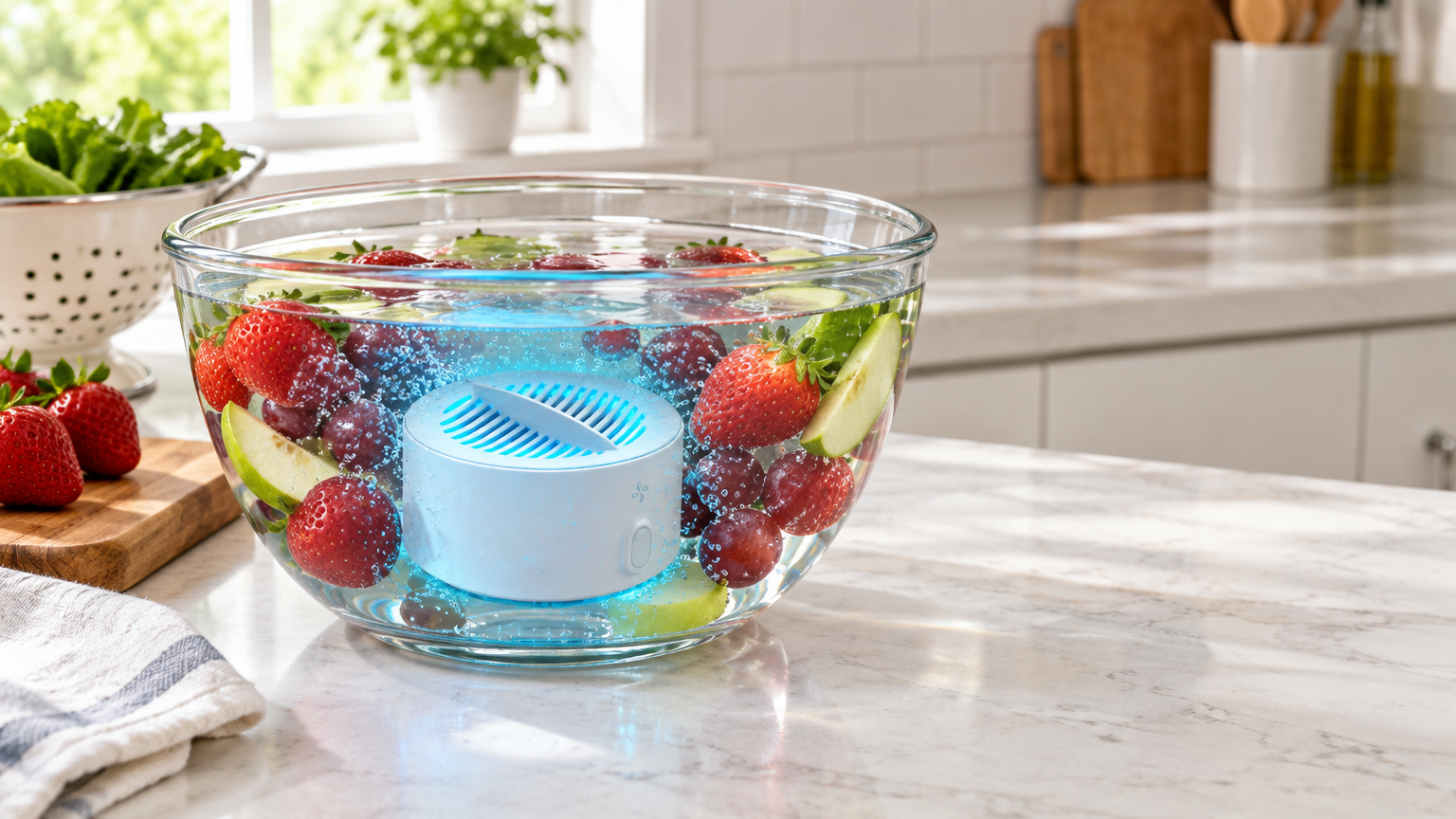
The device does real chemistry. OH-ion electrolysis generates reactive oxygen species in water, and the oxygen microbubbles physically lift debris off the surface of the fruit. That mechanism is used in industrial food processing. What it is not is selective chemistry: it does not hunt down pesticide molecules and dismantle them, and no independent laboratory test of this specific model is published. Effectiveness depends on concentration, contact time and how much organic matter is already in the water.
The honest UK framing: the PRiF programme tests food on the shelf against legal maximum residue limits, and the FSA investigates outbreaks. Neither of those removes the wax film, the handling grit, or the residue sitting on the surface of the pepper in your fridge. A bowl cycle addresses that layer — the one after the regulator, not instead of them.
Two practical warnings. The checkout does not state which currency it is charging in. And shipping is added at payment, not shown on the package screen.
Readers searching how to remove pesticides from fruit, whether PuriBreeze is worth it in the UK, or looking for a PuriBreeze review for UK buyers will find the same core question answered here. This assessment is document-based: it draws on the seller's specifications and claims, the checkout prices and currency behaviour we observed, public information from the Food Standards Agency, the HSE's PRiF programme, the Food Standards Code framework, and public literature on electrolysis. No laboratory test was carried out.
Quick facts
- Technology
- OH-ion electrolysis generating oxygen microbubbles
- Cycle
- About 5 minutes, one button
- Rating
- IPX7, fully submersible
- Power
- Cordless, rechargeable
- Claimed removal
- Up to 99% of pesticides and bacteria (seller's claim, no independent test published)
- Best realistic use
- Wax, grit and surface residue on produce eaten raw
- Not a substitute for
- Cooking, sourcing, or PRiF testing and FSA oversight
- Price
- From £79.99 per unit on the 4-pack; £99.95 single
- Shipping
- £6.95 to £9.90 by pack size, added at payment
- Checkout currency
- Figure only; currency not stated on the package screen
What the UK actually tests
The UK runs its own residue programme, and it is not the American one. The PRiF programme — Pesticide Residues in Food — is run by the Health and Safety Executive. It tests samples of food sold in the UK every year and publishes the results, including which samples exceeded the legal maximum residue limit.
That matters for how you read the famous 'Dirty Dozen' list. That list is published by the Environmental Working Group, an American organisation, based on American testing. It is not a UK regulator's list and it is not derived from PRiF data. Some of the same produce appears in UK results, but the ranking you see quoted is American. Treat it as a rough guide, not a British finding.
And here is the point most cleaning-device pages skip. A maximum residue limit is a compliance threshold, measured at the point of test. It is not a cleaning instruction, and it is not a measure of how much wax or grit is sitting on the surface of the produce in your kitchen.

The 2024 salad leaf outbreak, and what it means
In 2024 the UK recorded an E. coli outbreak linked to salad leaves. The Food Standards Agency led the investigation, and the episode prompted a wider conversation about how leafy produce is washed and handled before it reaches a bag.
Read that carefully, because it cuts both ways. It is not evidence that a countertop device would have prevented it: E. coli contamination on salad leaves is typically a pathogen attached to the leaf surface and sometimes drawn into the leaf structure through the cut stem, and a five-minute bowl cycle is not a validated disinfection step. The control that mattered in that outbreak was supply-chain investigation and product withdrawal, and that is the FSA's job.
This is not a crisis narrative. The system responded. The question is whether a better rinse is worth around £100 to you as a habit, and that is a different question from whether your salad is safe.

Cleaning methods compared
The table below compares common approaches on the criteria that matter. The bottom row reflects the seller's own claims, which we have marked as such.
| Method | Lifts dirt and grit | Reduces surface residue | Kills pathogens | Evidence base |
|---|---|---|---|---|
| Water rinse only | Partial | Limited | No | Standard kitchen practice |
| Vinegar soak | Yes | Some, on some produce | Inconsistent | Mixed published results |
| Bicarbonate of soda soak | Yes | Some, on some produce | No | Mixed published results |
| Vegetable brush | Yes | Limited | No | Physical removal only |
| PuriBreeze OH-ion (per seller) | Yes | Plausible mechanism, unquantified | Claimed by seller, not independently verified | No published independent test of this model |
The bottom row is the one that matters. The seller claims up to 99% removal of pesticides and bacteria. No independent laboratory test of this specific model has been published, so the claim cannot be verified — and a page that presents it as settled fact would be misleading you.
What a 5-minute cycle can and cannot do
What it can do
- Lift visible dirt and grit
- Soften and strip the wax coating applied to apples, peppers and citrus
- Reduce surface residue (plausible mechanism, unquantified by any published test)
- Make a rinse more thorough than holding produce under the tap
- Give you a repeatable routine with no measuring
What it cannot do
- Kill pathogens inside tissue, which is what drove the salad leaf outbreak
- Guarantee 99% removal of anything (a seller's claim)
- Extend shelf life fivefold (no published basis)
- Replace cooking
- Substitute for PRiF testing or FSA investigation
- Remove a chemical treatment applied before shipment
What it actually is
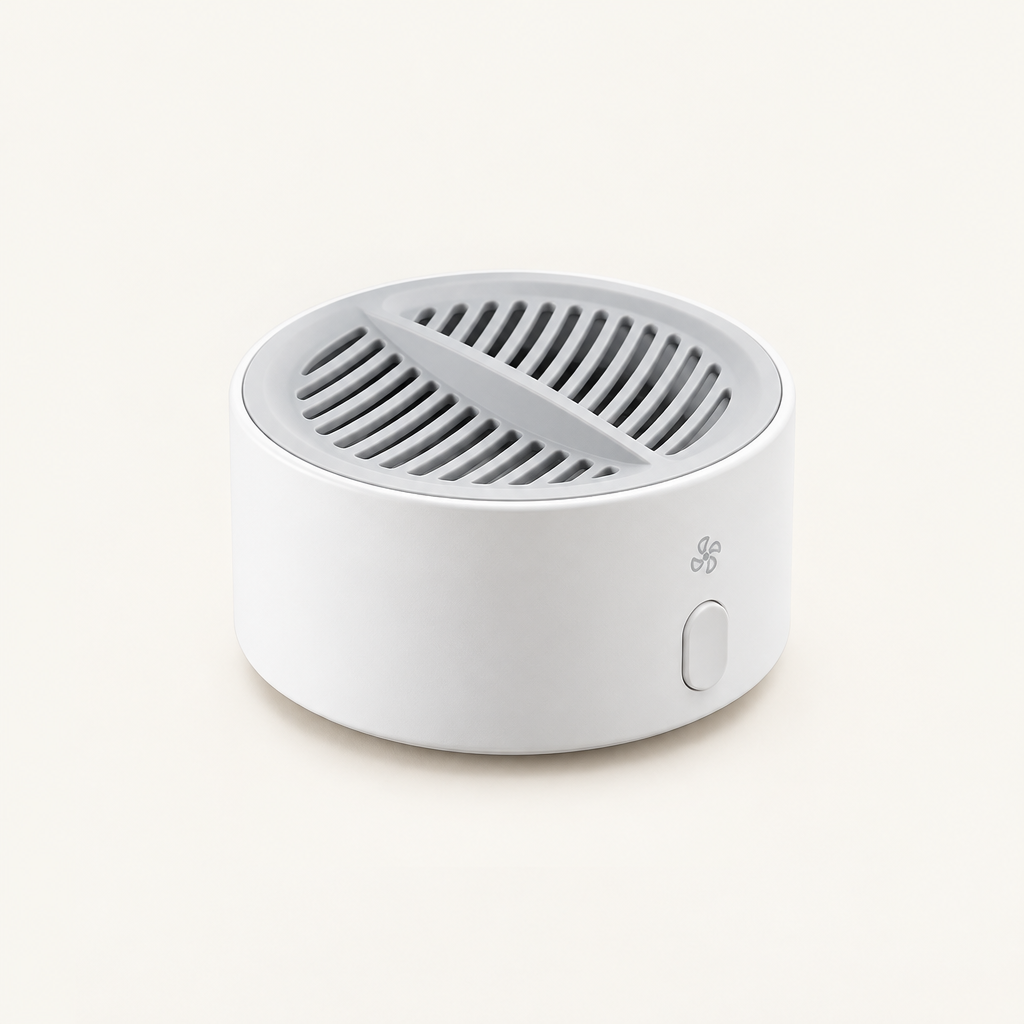
The PuriBreeze is a compact, low-profile puck — matte white, roughly the size of a large doughnut, and about as heavy as a full mug. The whole interface is one oval button on the side, under a small printed fan icon. There is no display, no app, no dial. The top is a circular grey grille divided by a cross bar, and that grille is where the light comes out when it is working. It is rated IPX7 and it runs cordless, so the entire cycle happens with the unit fully underwater.
The five-minute routine
- Fill a bowl with tap water.
- Add the produce.
- Press the button and wait five minutes.
- Lift, rinse under the running tap, and refrigerate.
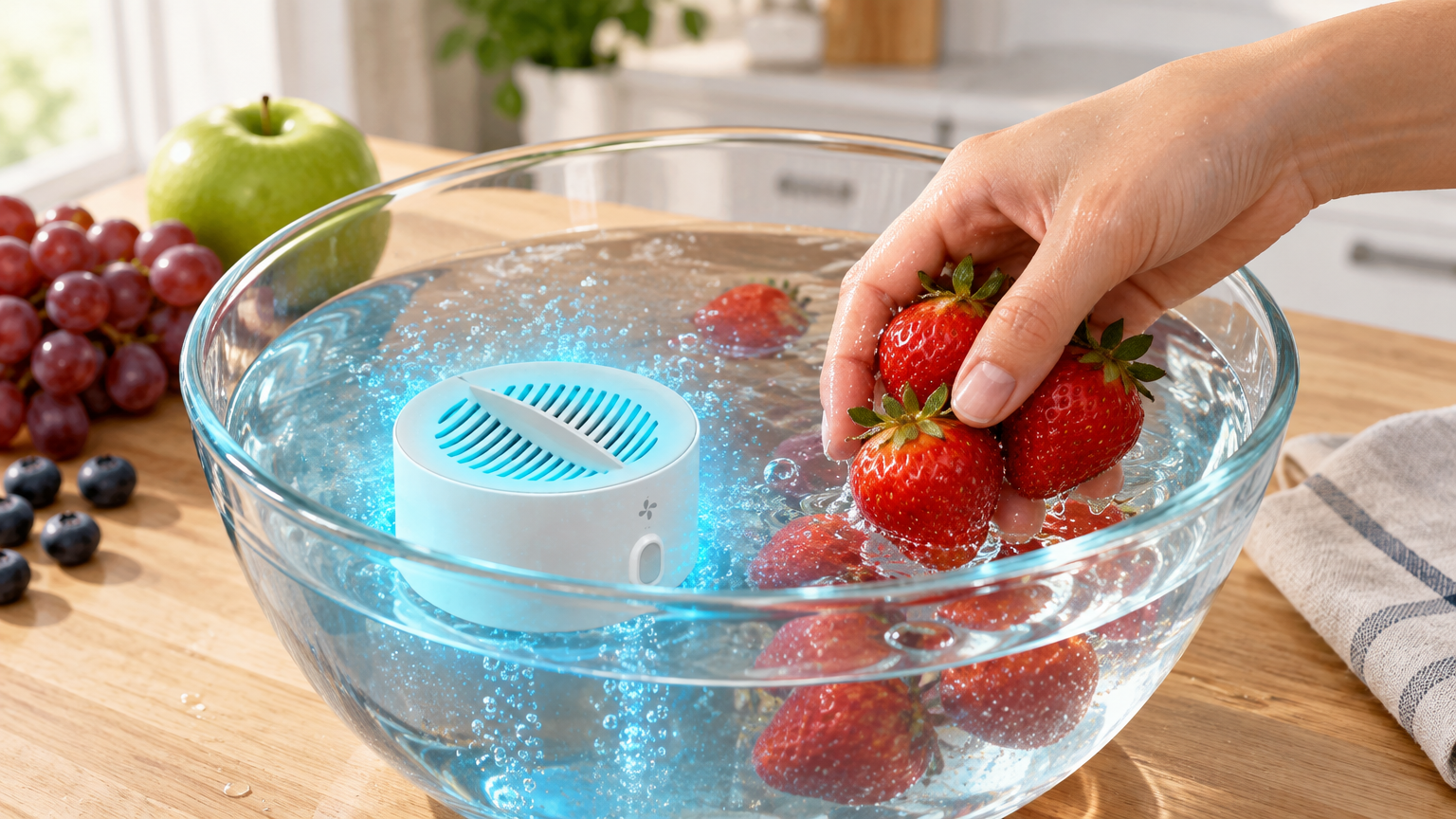
The device is not doing anything you could not do with a bowl and patience. What it adds is consistency: five minutes, no measuring, no vinegar smell, no decision to make.
The real cost per use
Single purchase, no consumables.
| Option | Upfront | Per wash | Over 2 years |
|---|---|---|---|
| PuriBreeze | £99.95 | ~£0.02 | ~£99.95 |
| Produce wash spray | £0 | ~£0.35 | ~£180 |
| Vinegar soak | £0 | ~£0.10 | ~£50 (plus the smell) |
Break-even against a produce spray lands around 30 washes — roughly two months of normal use. UK electricity is currently capped per unit by Ofgem; the marginal cost of a five-minute cycle is a fraction of a penny.
Prices and the currency warning
Before you order: the checkout does not tell you which currency you are being charged in. The figures match the US price list exactly — 99.95, 89.99, 86.95 and 79.99, with the same struck-through prices and the same discount percentages — and the currency is not stated on the package-selection screen. Treat it as a US-dollar charge until the seller confirms otherwise. Your card issuer will apply its own exchange rate and may add a non-sterling transaction fee, so the amount on your statement will not match the figure on screen. Ask before you pay.
The package figures below are what appears at checkout. We have labelled them with the pound sign for readability, but that label is ours, not the seller's — the page itself does not say.
Shipping is added at the payment step — it is not shown on the package-selection screen. One unit is enough for a household. Multi-packs only make sense for gifting or a second kitchen.
Safety and the IPX7 claim
IPX7 means the unit is protected against immersion up to 1 metre for 30 minutes. It is a water-ingress rating, not a food-contact certification. Use potable water, discard it after the cycle, and do not leave produce sitting in the bowl afterwards.
IPX7 is a water-ingress rating, not a food-safety certification. If a seller implies it means 'safe for food', that is a conflation. Rinse your produce under running water after the cycle — that step is in the seller's own instructions, and it is also standard UK food hygiene advice.
Who it's for — and who it isn't
For
- Real electrolysis chemistry
- Cordless and fully submersible
- Five-minute, one-button routine
- Helps with wax and surface grit
- No consumables to rebuy
- IPX7 rating
Not for
- No independent test published
- "99%" is a seller claim
- Does nothing about pathogens inside tissue
- "5x shelf life" is unsupported
- Checkout currency is not stated
- Around £100 is a lot for a rinse aid
Frequently asked questions
What is PuriBreeze?
A cordless, fully submersible produce cleaner that uses OH-ion electrolysis to generate oxygen microbubbles in a bowl of water. It runs a cycle of about five minutes with one button.
How does OH-ion electrolysis work?
An electric current passes through water, producing reactive oxygen species including hydroxyl radicals, along with oxygen microbubbles that can lift debris from surfaces. The process is used industrially, but its effect depends on dose, contact time and organic load.
Does it remove 99% of pesticides?
99% is the seller's claim. No independent laboratory test of this specific model has been published, so the figure cannot be verified.
Does it kill bacteria like E. coli and Salmonella?
The seller claims it does. Effectiveness depends on concentration, contact time and water load, and no published independent test confirms the claim for this device. It does not reach pathogens inside tissue, which is the relevant mechanism in salad leaf outbreaks.
Is the Dirty Dozen relevant to the UK?
The Dirty Dozen is published by the Environmental Working Group in the United States, based on American testing. The UK's own programme is PRiF, run by the Health and Safety Executive, which tests UK food samples annually. Some of the same produce appears in both, but the ranking you see quoted online is American.
Doesn't the FSA already test produce?
The FSA investigates incidents and outbreaks, and the PRiF programme tests residues against legal maximum residue limits. That is a compliance regime. It does not remove surface wax or grit from what you bring home.
What currency does the checkout charge in?
The checkout displays a figure without stating the currency, and the number matches the US price list exactly. Treat it as a US-dollar charge and confirm with your card issuer about non-sterling transaction fees.
How much is shipping?
£6.95 for one unit, £7.90 for the 2-pack, £8.95 for the 3-pack and £9.90 for the 4-pack. Shipping is added at the payment step and is not shown on the package-selection screen.
Does it need salt or additives?
No additives are required according to the seller's instructions. Use potable water and discard it after the cycle.
How does the 30-day guarantee work?
According to the seller, you can return the device within 30 days for a money-back refund. Confirm in writing who pays return shipping before ordering, since the return address is overseas.
Verdict
PuriBreeze is a plausible cleaning aid for wax, grit and surface residue on produce you eat raw. It is not a verified pesticide or pathogen remover, the 99% figure is the seller's own, and the checkout currency and shipping are not presented clearly. The UK system of residue testing and outbreak investigation does the job it is designed for. A bowl cycle is an optional extra for a better rinse, not a safety requirement.
Pay with Visa, Mastercard, Amex, Discover, PayPal, Apple Pay, Google Pay or Klarna — check your card's non-sterling transaction fee first