Rust Removal Compared: What Each Method Actually Costs Per 100ml
The short answer
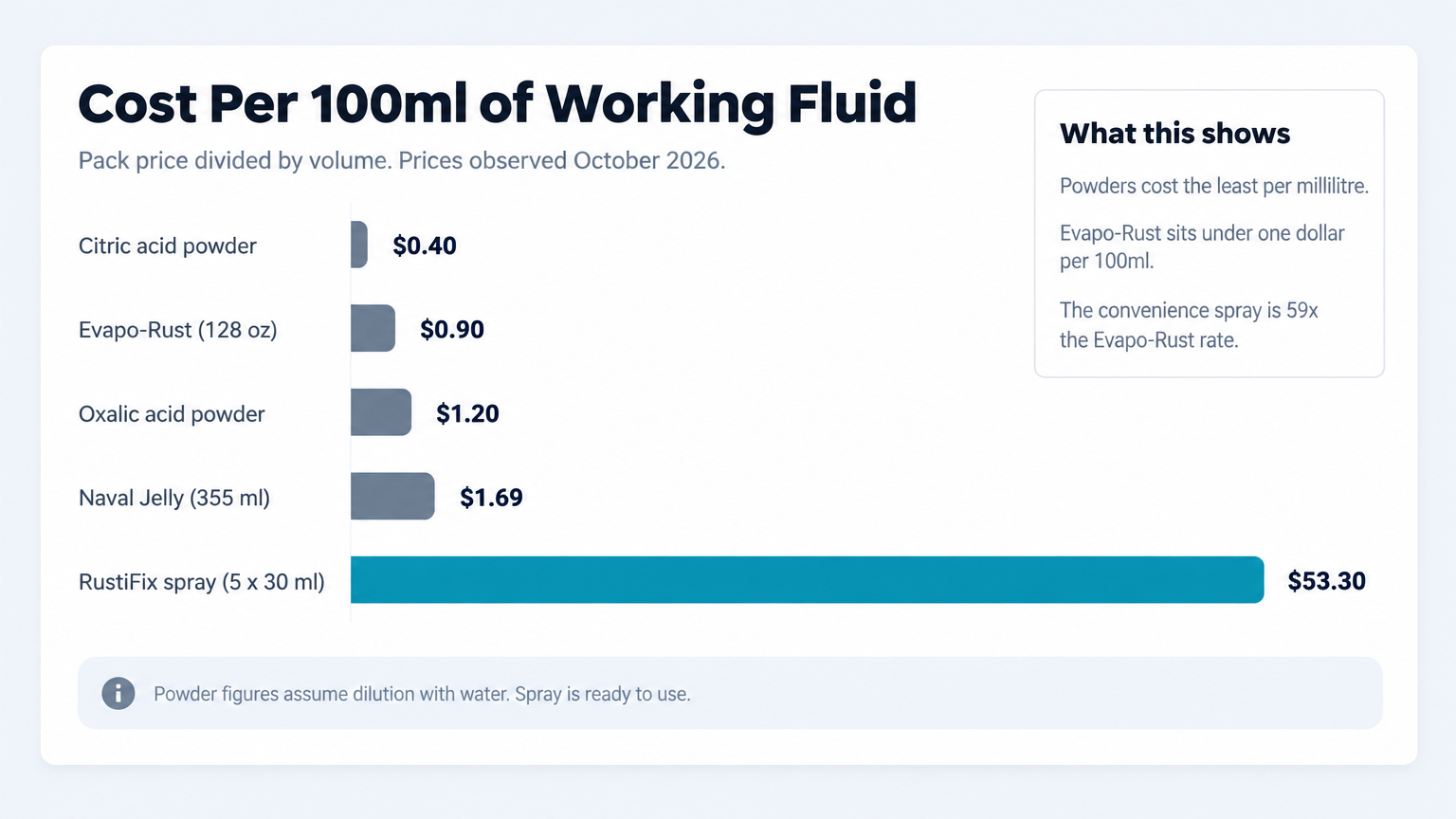
Rust removal is one of the few home-repair jobs where the cheapest method is also one of the best. A tub of citric acid powder costs about $0.40 per 100ml of working solution. Evapo-Rust, the chelation product professional restorers reach for, works out around $0.90. A pre-mixed convenience spray like RustiFix costs $53.30 per 100ml — roughly 59 times the citric acid equivalent and 59 times Evapo-Rust. That does not make it useless. It makes it a convenience purchase, and this page shows you the arithmetic so you can decide whether the convenience is worth it.
Every article that ranks for "best rust remover" tests products. This one does the maths instead. The chemistry of rust removal is well documented, the products are widely available, and the prices are public — which means you can actually compare them per unit of working fluid. That comparison is what most buyers never see.
Want to check the current RustiFix price?
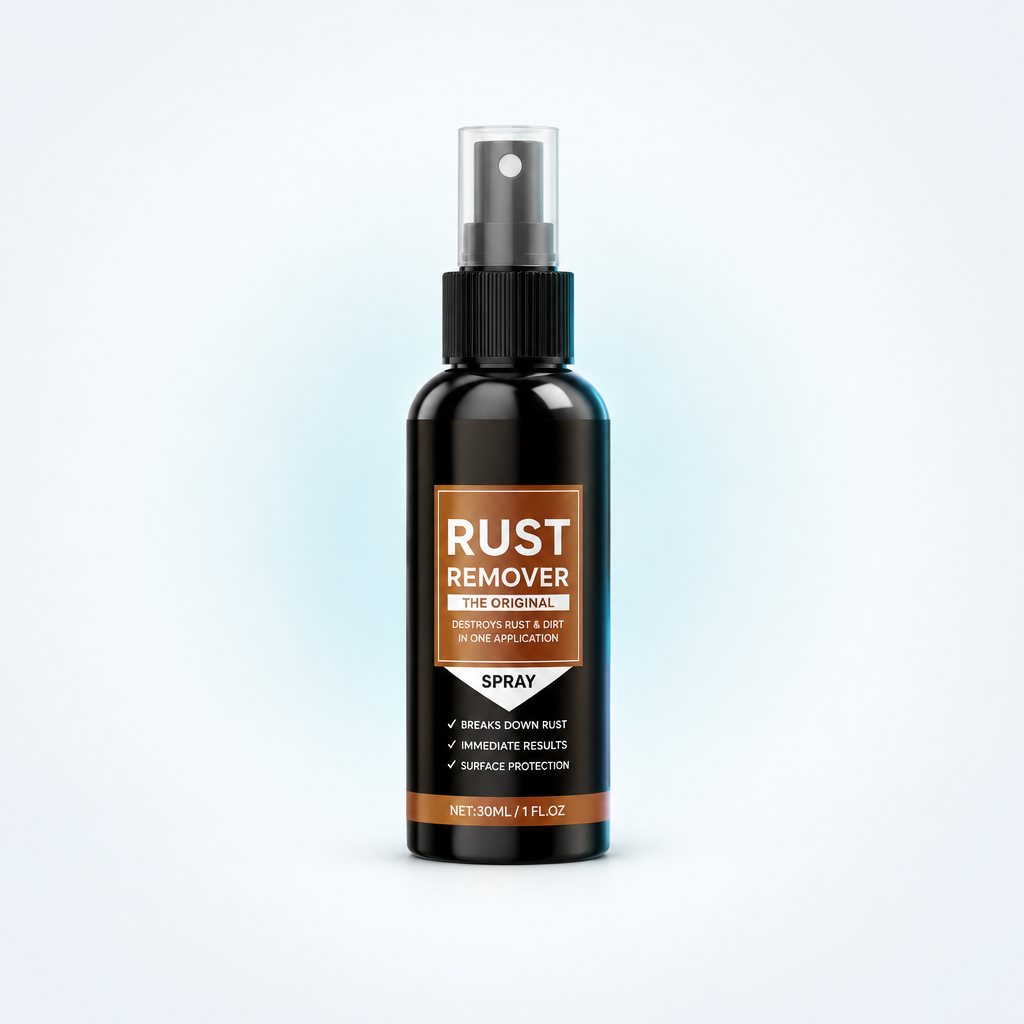
One bottle is 30ml. At the best bundle tier that is $15.99 per bottle. Read the cost section below before you decide.
Check current pricing → Affiliate link · 30-day return window per the sellerThe four methods, explained
Two dissolve the oxide, one binds to it selectively, and one uses electricity to pull it off.
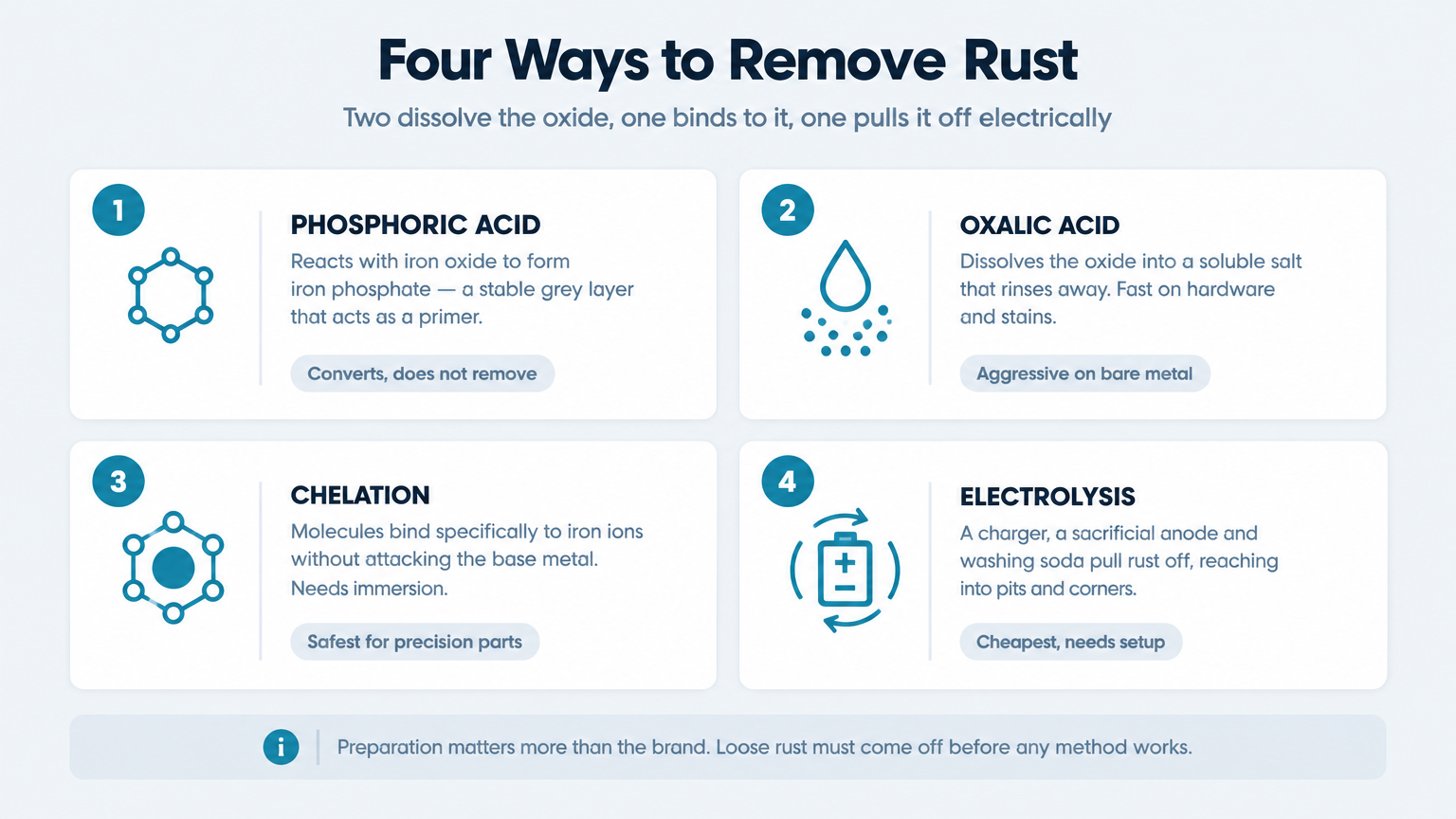
There are four ways to get rust off metal, and they behave very differently. Two dissolve the oxide, one binds to it selectively, and one uses electricity to pull it off. Knowing which is which tells you what to expect before you spend anything.
Phosphoric acid (conversion)
The most common industrial approach, and what products like Naval Jelly use. It reacts with iron oxide to form iron phosphate — a grey, stable layer that adheres to the surface and acts as a mild primer. It does not remove heavy rust quickly; it converts the outer layer and leaves loose rust underneath if you do not wipe it away.
Oxalic acid (dissolution)
Dissolves the oxide into a soluble salt that rinses away. Fast and effective on hardware and stains. More aggressive than chelation, and it will attack bare metal if left on too long.
Chelation (selective binding)
The Evapo-Rust approach. Molecules bind specifically to iron ions from rust without attacking the base metal. Slower, needs immersion rather than spraying, but the safest option for precision parts and anything you cannot afford to damage.
Electrolysis (home method)
A battery charger, a sacrificial anode, washing soda and water. Costs almost nothing to run and removes rust from pits and corners where nothing else reaches. Requires setup, space and a power source, which is why it is not a shelf product.
What each method actually costs
Price divided by working volume, calculated from October 2026 retail prices.
This is the comparison nobody publishes. Every figure below is price divided by volume of working fluid, calculated from retail prices observed in October 2026.
| Method | Typical cost | Volume basis | Cost per 100ml | Best for |
|---|---|---|---|---|
| Citric acid powder | $0.40 per 100g | Mixed with water | $0.40 | Bulk jobs, soaking, budget |
| Oxalic acid powder | $1.20 per 100g | Mixed with water | $1.20 | Stains, hardware, fast results |
| Evapo-Rust | $33.92 | 3,785ml (128oz) | $0.90 | Precision parts, repeated use |
| Naval Jelly | $6.00 | 355ml | $1.69 | Vertical surfaces, conversion |
| RustiFix spray | $79.95 | 150ml (5×30ml) | $53.30 | Small, awkward spots |
If you want the spray anyway, buy the 5-bottle tier
$15.99 per bottle at five bottles, against $24.95 at two. The per-ml cost is still the highest here, but at least you are not paying the worst tier.
View the 5-bottle price → Affiliate link · confirm the return terms at checkoutWhere RustiFix fits
A ready-to-use spray for spot work, judged on cost, coverage and convenience.
RustiFix sits at the convenience end of the table. It needs no mixing, no container and no immersion, and it applies directly to the spot that needs treating. Those are real advantages for a single fastener. They are also the reason its price per millilitre is so much higher than the bulk options.
The 30ml problem
Bottle size decides whether a product is good value, and marketing rarely mentions it.
Bottle size is the detail that decides whether a product is good value, and it is the one the marketing never mentions.
| Product | Volume | Realistic coverage |
|---|---|---|
| RustiFix | 30ml | One hinge, a few bolts, a door latch |
| Naval Jelly | 355ml | A gate, a full set of hand tools |
| Evapo-Rust | 3,785ml | A vise, a plane, multiple tool restorations (reusable) |
| Citric acid mix | 5 litres | Anything that fits in a bucket |
What the manufacturer doesn't say
The claims on the label, set against the details that are missing.
RustiFix does not publish its active ingredient. That is not illegal, but it matters, because the three chemical families above behave very differently and you cannot tell which one you are buying.
| What the seller states | What it does not state |
|---|---|
| "Deep rust removal formula" | The active chemical and its concentration |
| "No-damage metal care" | Which metals were tested, or by whom |
| "Built-in rust protection" | Whether this is a phosphate conversion layer or a coating |
| "Immediate results" | Contact time required, or whether heavy rust needs repeat application |
How to choose
Match the method to the job, not the other way round.
One rusty bolt, no equipment
The spray, or a small Naval Jelly tub. Pay the convenience premium knowingly. Do not buy a 3.8-litre jug to fix a hinge.
A box of old tools
Evapo-Rust, in a container big enough to submerge them. It is reusable, it does not attack the base metal, and it will not mark the finish.
A gate, a railing, anything large and vertical
Naval Jelly. It is a gel, so it stays where you put it. The spray will run. Powders need immersion, which is impossible here.
Restoring something valuable
Chelation or electrolysis. Both are gentle on the base metal. Acid will etch a fine finish you cannot get back.
Check the RustiFix price with the arithmetic in hand
$53.30 per 100ml against $0.90 for Evapo-Rust. Buy it if the spot-treatment convenience is what you need.
View current RustiFix pricing → Affiliate linkFrequently asked questions
Nine questions readers ask most, answered from the figures above.
Is RustiFix worth the money?
What is actually inside RustiFix?
What is the cheapest way to remove rust?
Does Evapo-Rust really work?
Phosphoric acid or chelation?
Can I use vinegar?
How much does a 30ml bottle actually treat?
Will a rust remover stop rust coming back?
Are these prices still accurate?
Where this leaves you
Nothing on this page is an argument that RustiFix does not work. A spray that breaks down rust in ten minutes and wipes off is doing real chemistry. The argument is about price per unit of working fluid, and on that measure it is the most expensive thing here by a wide margin.
If your job is one seized bolt behind a car battery and you own no buckets, no powders and no patience, it is a reasonable purchase. If your job is a shed full of tools, buy Evapo-Rust or a bag of citric acid and put the difference toward the tools themselves.
Disclaimer: This page is information and commentary, not engineering, chemical or safety advice. Gadget Gear Reviews is not the manufacturer or seller of any product compared here. Prices are as observed in October 2026 across retail and online sources and change frequently. Cost-per-100ml figures are calculated by dividing pack price by pack volume; they do not account for dilution ratios of powders, which vary. Third-party findings are attributed to their sources.
Affiliate disclosure: this page contains affiliate links. We may earn a commission if you purchase, at no additional cost to you. The comparison above is written to the same standard we apply to non-affiliate content.